What Is Robinhood Chain and Where Lighthouse Fits In
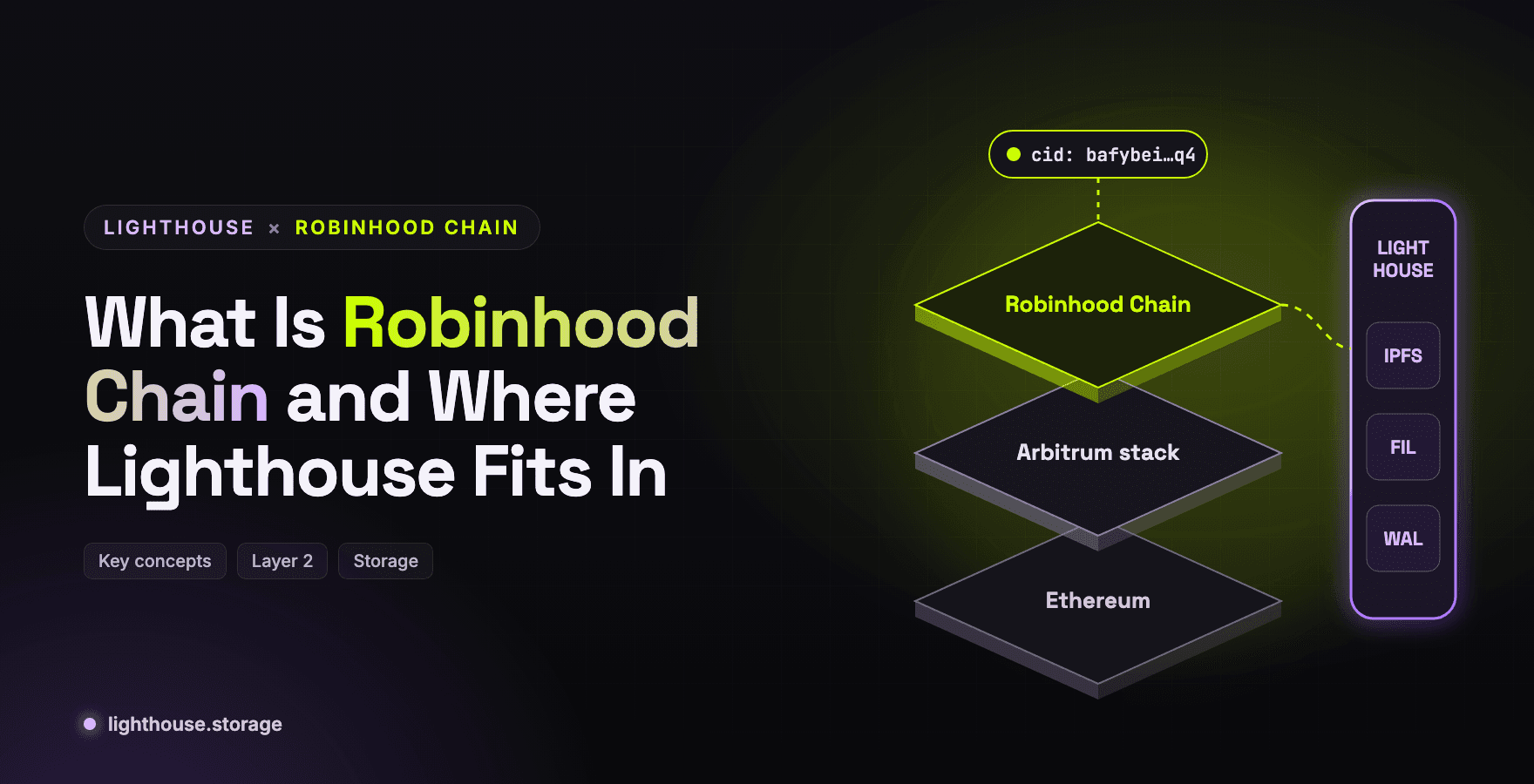
Robinhood Chain moves stocks, stablecoins and agents onchain. Everything those assets need to be trusted, from disclosures to images to agent logs, still has to live somewhere. That is the job Lighthouse does.
On July 1, 2026, at its "The World is Flat" event in London, Robinhood launched the public mainnet of Robinhood Chain. It arrived with Stock Tokens trading 24/7, a dedicated Uniswap deployment, perpetuals from Lighter, lending from Morpho, and a stated ambition to be the chain where AI agents trade real world assets.
Most coverage stopped at the trading. This post covers what builders need: what the chain actually is, how it differs from the Layer 2s you already know, and which piece of the stack is missing from the launch announcement.
Robinhood Chain at a Glance
| Robinhood Chain | |
|---|---|
| Type | Ethereum Layer 2, permissionless |
| Stack | Arbitrum technology (Arbitrum Dedicated Blockchains, formerly Orbit) |
| Mainnet | Live since July 1, 2026 |
| Public testnet | February 2026 |
| Mainnet chain ID | 4663 |
| Testnet chain ID | 46630 |
| Gas token | ETH, no native token |
| Block time | 100 ms |
| Sequencing | First come, first served |
| Account abstraction | First class ERC-4337, with gas sponsorship and session keys |
| Explorer | robinhoodchain.blockscout.com |
| Core partners | Alchemy, LayerZero, Chainlink, Uniswap, Morpho, Lighter, Paxos (USDG) |
Three things in that table matter more than they look.
ETH for gas, no native token. Robinhood did not launch a token to pay for blockspace. Fees are paid in ETH, the same as Arbitrum One and Base, which means every existing EVM wallet and tool works without special handling.
First come, first served sequencing. Transaction order is decided by arrival time at the sequencer, not by who bids the highest priority fee. For a chain built around trading tokenized equities, that is a deliberate choice against the priority auctions that make MEV extraction easy.
First class account abstraction. ERC-4337 support with gas sponsorship and session keys is what makes AI agents practical. An agent can hold a session key scoped to specific actions and a spending limit, and never touch the owner's main key.
What Actually Runs on Robinhood Chain
Stock Tokens. Tokenized exposure to equities such as NVIDIA, Apple and Google. They are tokenized debt securities issued by Robinhood Assets (Jersey) Limited, available to eligible users in more than 120 countries through Robinhood Wallet. They are not available in the United States and are restricted in several other jurisdictions. Onchain, they can be traded around the clock, deposited into lending pools, and used as collateral.
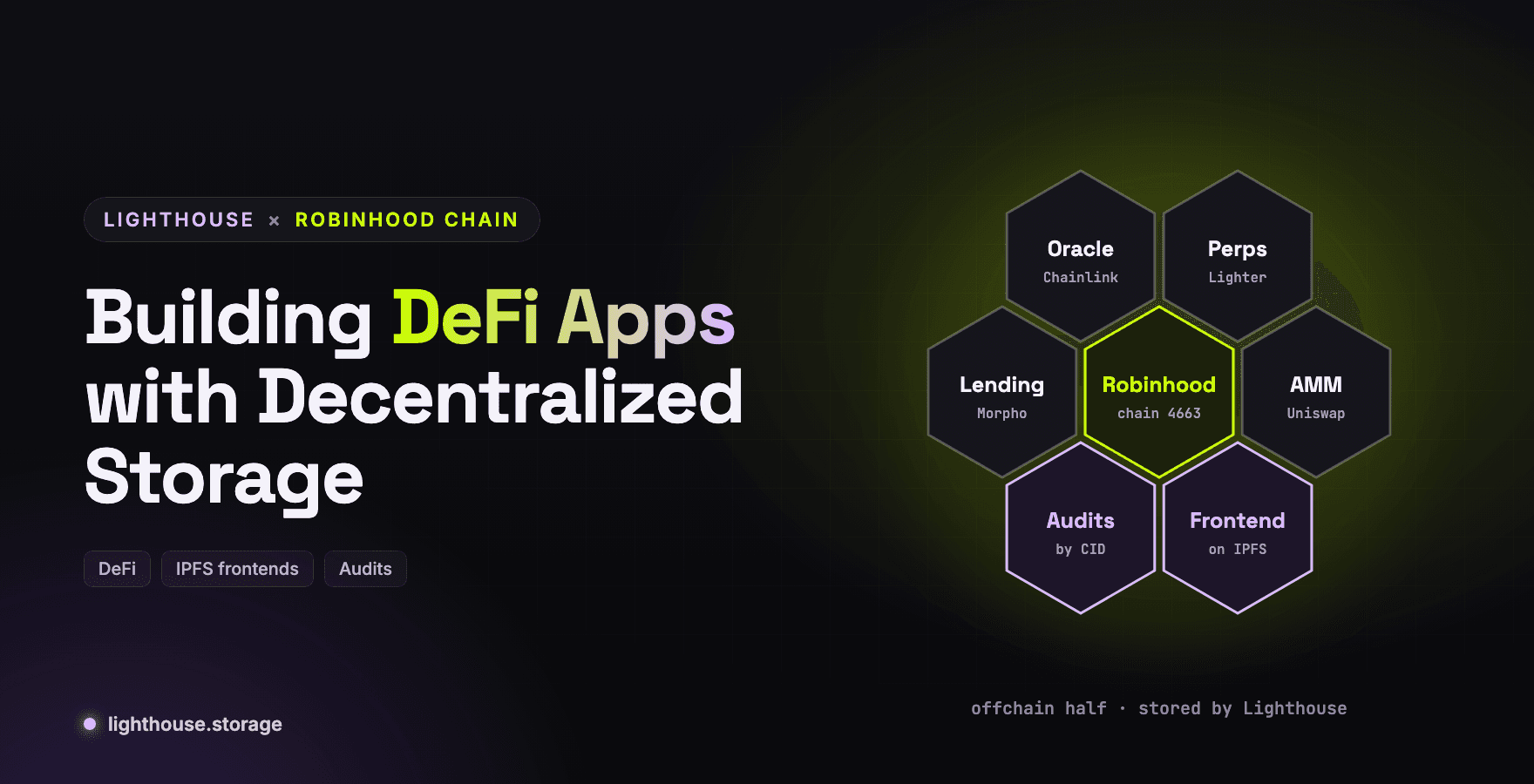
DeFi primitives. Uniswap deployed a dedicated AMM as the primary public liquidity venue. Morpho handles lending. Lighter and Arcus bring perpetuals. Chainlink supplies oracles and LayerZero carries cross chain messaging. Paxos issues USDG as a native dollar stablecoin.
AI agents. Robinhood describes the chain as AI native and "purpose built for AI agents" that trade, swap, lend and transact with tokenized assets. Crypto focused Agentic Accounts are rolling out in the US.
For a developer, none of this requires new tooling. Hardhat, Foundry, viem, ethers and Wagmi all work. Add the network and deploy.
// viem chain definition for Robinhood Chain mainnet
import { defineChain } from "viem";

export const robinhoodChain = defineChain({
  id: 4663,
  name: "Robinhood Chain",
  nativeCurrency: { name: "Ether", symbol: "ETH", decimals: 18 },
  rpcUrls: {
    default: { http: ["https://rpc.mainnet.chain.robinhood.com"] },
  },
  blockExplorers: {
    default: { name: "Blockscout", url: "https://robinhoodchain.blockscout.com" },
  },
});
The Piece the Launch Did Not Cover
A blockchain is a very good ledger and a very bad hard drive. Writing 1 MB of data into contract storage on any EVM chain costs a large amount of gas, and nobody reads files from a state trie anyway.
Yet almost everything that makes an onchain financial asset trustworthy is a file:
- The disclosure document behind a Stock Token.
- The corporate action notice that changes its terms.
- The image and metadata of an NFT.
- The frontend a user signs transactions through.
- The trade log an AI agent produced before it moved money.
- The KYC packet a counterparty reviewed.
If those files live on a single company's server, the onchain asset inherits that server's weaknesses. The link can rot, the file can be quietly edited, and nobody can prove what a user saw at the moment they signed.
The fix is a pattern every serious EVM team ends up at: store the bytes in content addressed storage, and store only the content identifier onchain.
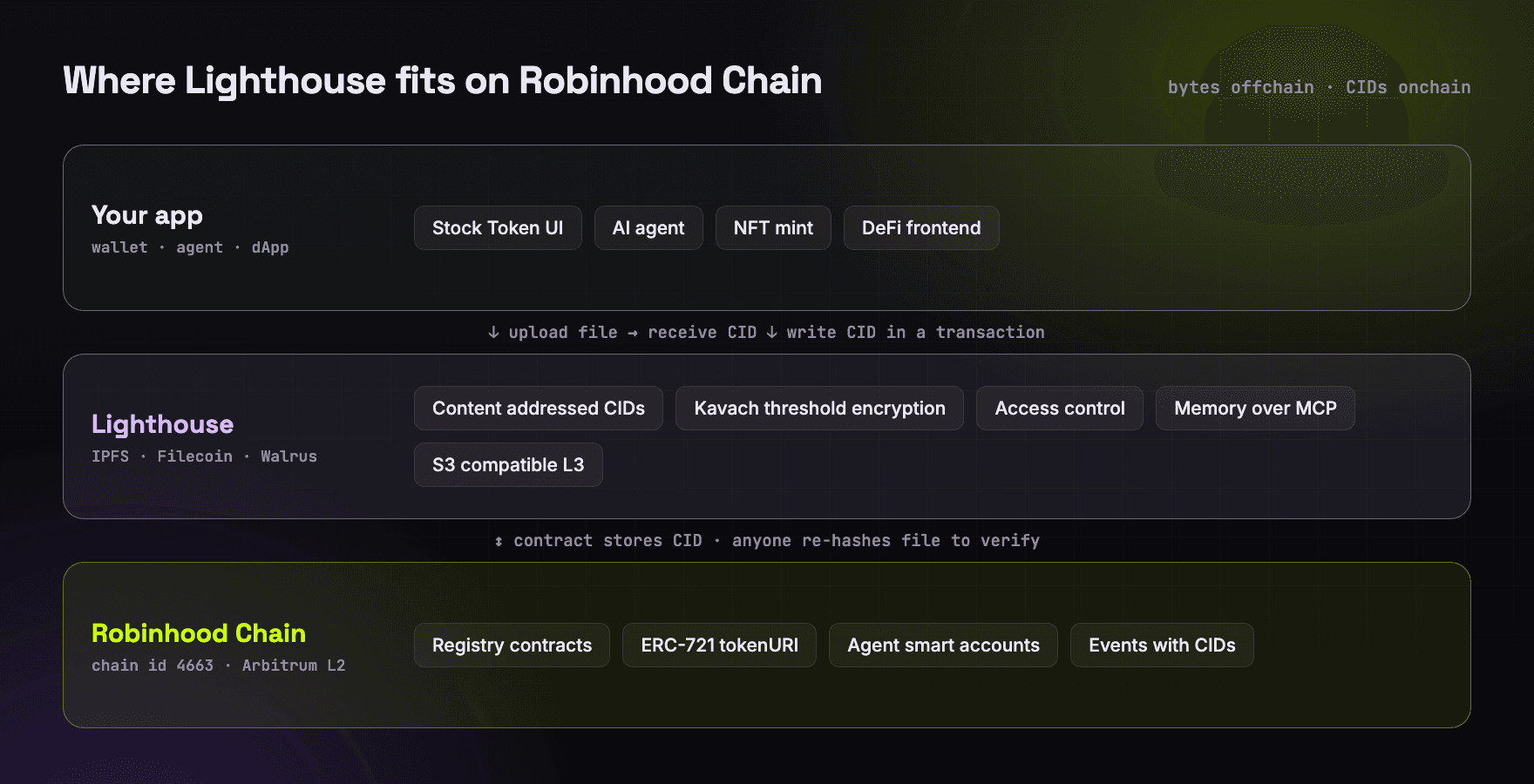
How Lighthouse Plugs Into Robinhood Chain
Lighthouse is a storage layer across IPFS, Filecoin and Walrus with client side encryption and programmable access control. For a Robinhood Chain app, it covers four jobs.
1. Content addressed files, anchored onchain
Upload a file and you receive a CID, a fingerprint derived from the bytes themselves. Change a single byte and the CID changes. Store that CID in your Robinhood Chain contract and you have an onchain commitment to exactly one version of the file. If you are new to CIDs, What Is a CID? Content Identifiers, v0 vs v1, and How to Read One covers how to read one.
import lighthouse from "@lighthouse-web3/sdk";

// 1. Upload the document and get its CID
const res = await lighthouse.upload("./disclosure-2026-q3.pdf", process.env.LIGHTHOUSE_API_KEY);
const cid = res.data.Hash;

// 2. Anchor the CID in your Robinhood Chain contract
await walletClient.writeContract({
  address: REGISTRY_ADDRESS,
  abi: registryAbi,
  functionName: "publishDocument",
  args: [assetId, cid],
  chain: robinhoodChain,
});
Note the ordering. Contracts cannot initiate uploads. Your application uploads through Lighthouse, gets the CID, then writes the CID to the chain.
2. Persistence you can verify
Files on the Filecoin path are backed by storage deals with onchain proofs, so "is my file still there" is something anyone can check rather than a promise. How to Verify Your File Is Actually Stored on Filecoin walks through it. Files on the Walrus path get erasure coded blob storage with fast reads.
3. Encryption before the file leaves the client
Public IPFS is not private. Anyone with a CID can fetch the bytes, which is fine for an NFT image and unacceptable for a KYC document. Lighthouse encrypts client side through Kavach, splits the key with BLS threshold cryptography across independent key nodes, and never holds a complete key. Lighthouse cannot read your files, and neither can storage providers.
4. Access control driven by onchain state
Decryption can be gated on ERC-20 balances, NFT ownership, native balances, time windows, or the return value of any custom contract. That is how token gated research, holder only documents and pay to view content get built.
Chain support note. Access conditions are evaluated by Lighthouse key nodes against chains they are configured to read. Robinhood Chain is not yet on the published Chains Supported list. Storage, CIDs, encryption and address based sharing work today on any chain. For conditions that read Robinhood Chain contracts directly, reach out on Discord; adding a chain is a configuration request, not a new product.
What to Build First
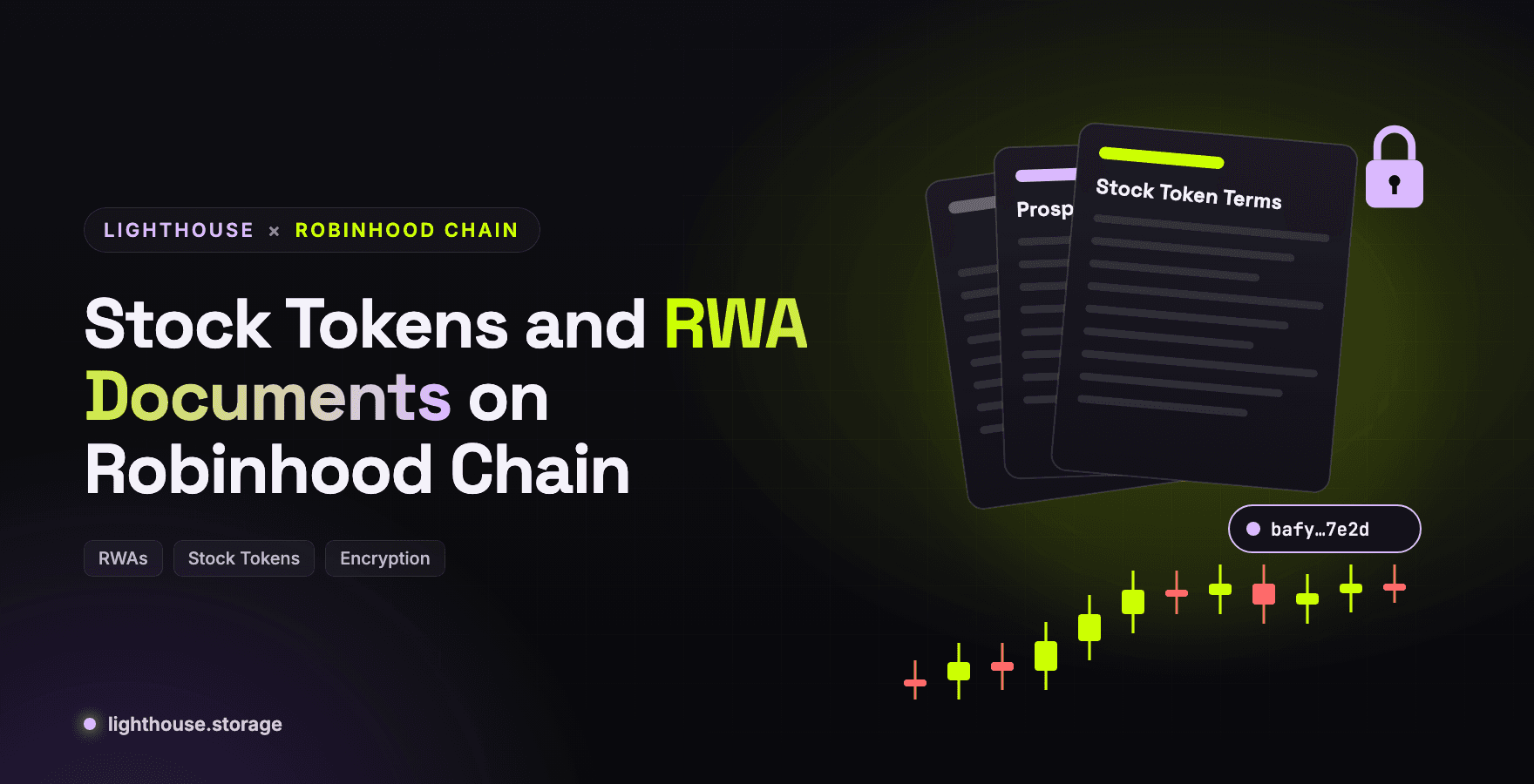
Stock Token and RWA data rooms. Disclosures, prospectuses and corporate actions stored by CID, with the CID written to a registry contract. Covered in depth in Stock Tokens and RWA Documents on Robinhood Chain with Lighthouse Storage.
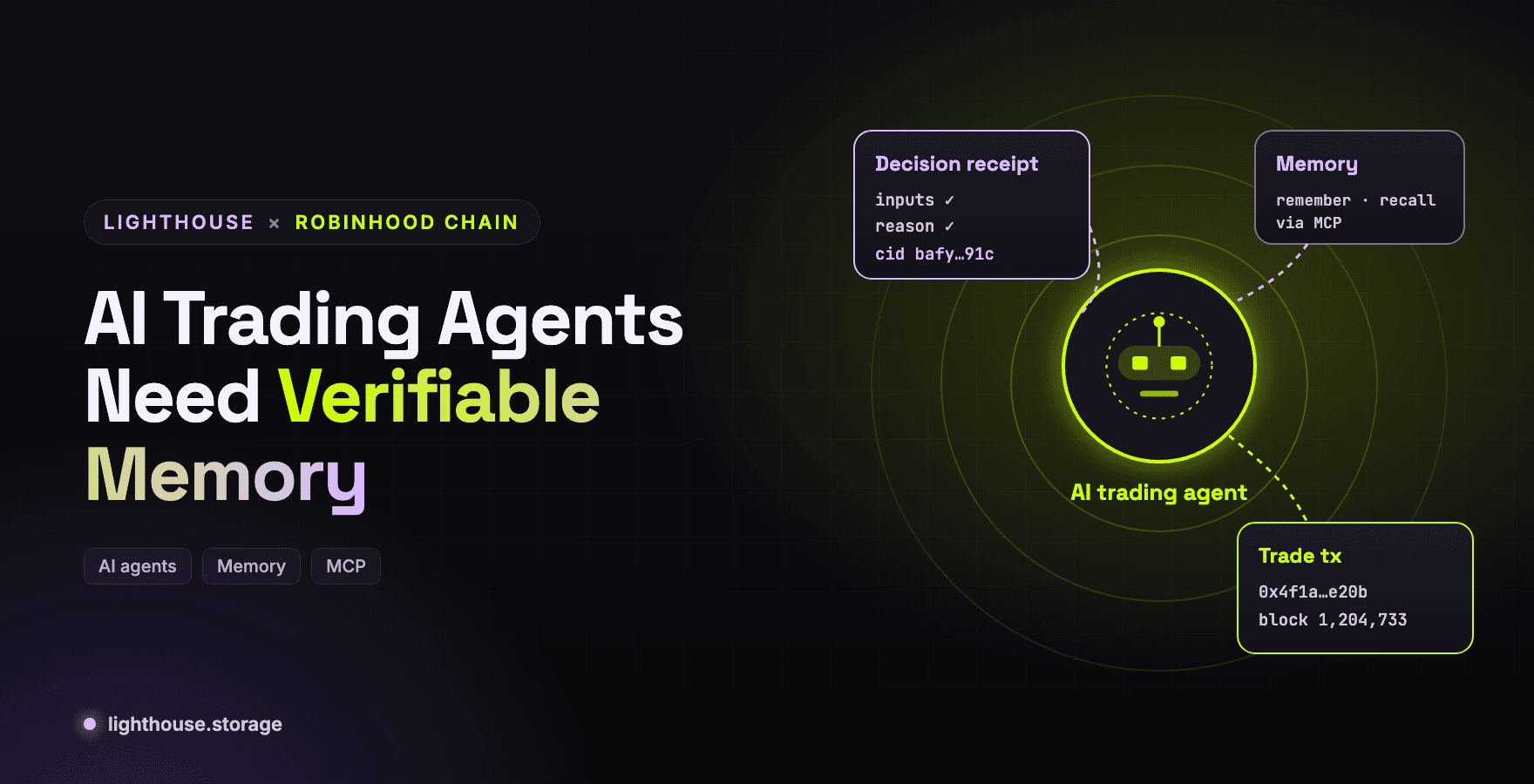
AI agents with receipts. Agents that record what they read and why they traded, as CIDs, so every action can be audited later. See AI Trading Agents on Robinhood Chain Need Verifiable Memory.
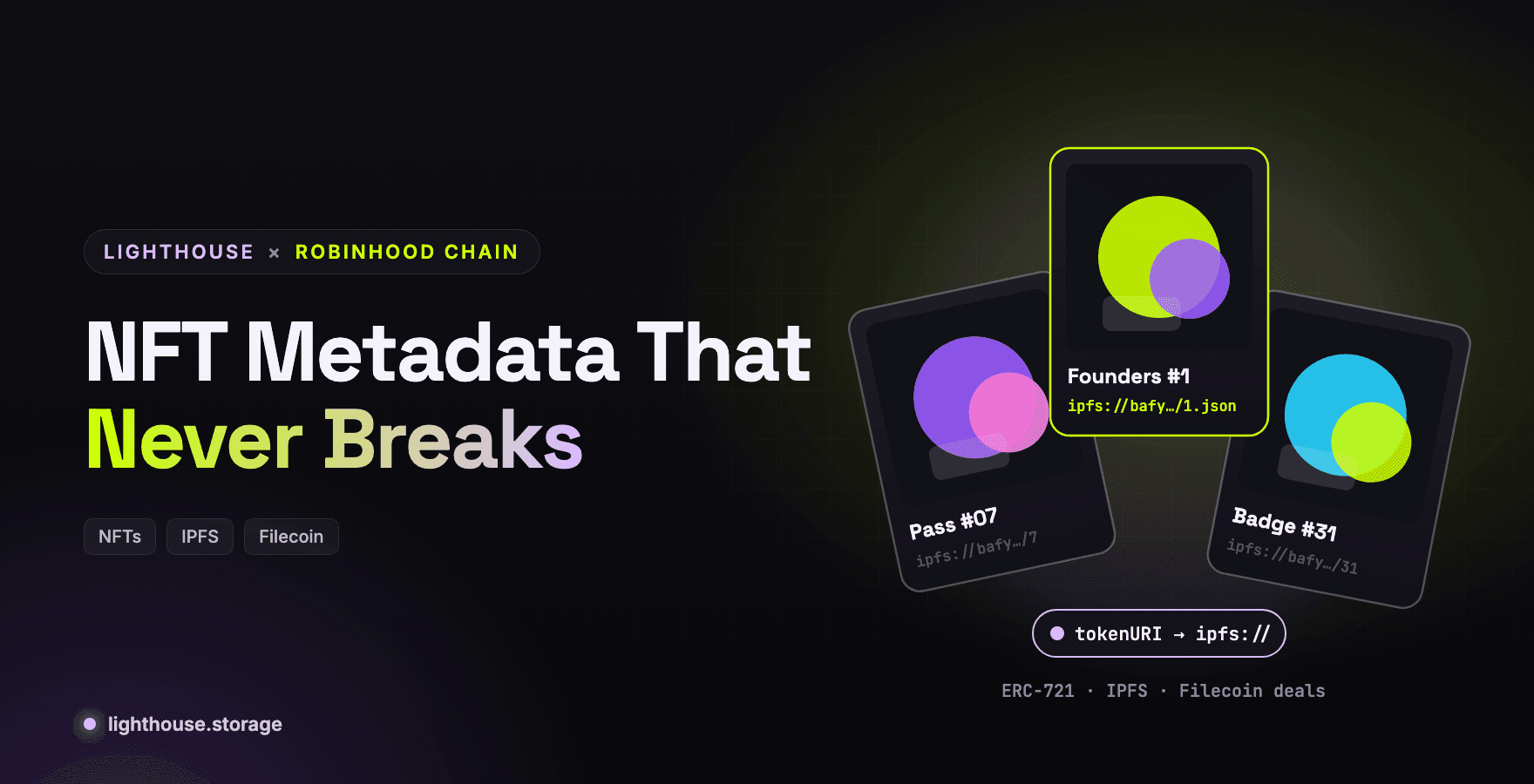
NFTs that do not break. Metadata and media on IPFS and Filecoin, referenced by ipfs:// URIs. See NFT Metadata on Robinhood Chain That Never Breaks.
DeFi apps with decentralized frontends. Frontends, oracle snapshots and governance documents hosted by CID. See Building DeFi Apps on Robinhood Chain with Decentralized Storage.
Frequently Asked Questions
What is Robinhood Chain? Robinhood Chain is a permissionless Ethereum Layer 2 built by Robinhood on Arbitrum technology. It is designed for financial services, tokenized real world assets such as Stock Tokens, and AI agents. Mainnet launched on July 1, 2026.
What is the Robinhood Chain chain ID?
Mainnet is 4663. Testnet is 46630.
Does Robinhood Chain have its own token? No. Gas is paid in ETH.
Can I store files on Robinhood Chain? You can, but storing file bytes in contract storage is extremely expensive. The standard pattern is to store the file with a service such as Lighthouse on IPFS, Filecoin or Walrus, and store the resulting CID onchain.
Is Lighthouse storage private? Only if you encrypt. Lighthouse offers client side threshold encryption, so encrypted files stay unreadable to Lighthouse and to storage providers. Unencrypted uploads to IPFS are public.
How much does it cost to start? Lighthouse has a free tier of 5 GB on the Filecoin path and 100 MB on the Walrus path, with no card required.
Get Started
- Create a Lighthouse API key
- Upload data
- Upload encrypted data
- Access control conditions
- Robinhood Chain developer docs
Building on Robinhood Chain and need storage your contracts can point at? Talk to our team.
Stay in Touch
Learn more at the website, docs, or GitHub. Join the community on Discord, X, Telegram, and LinkedIn.