AI Trading Agents on Robinhood Chain Need Verifiable Memory
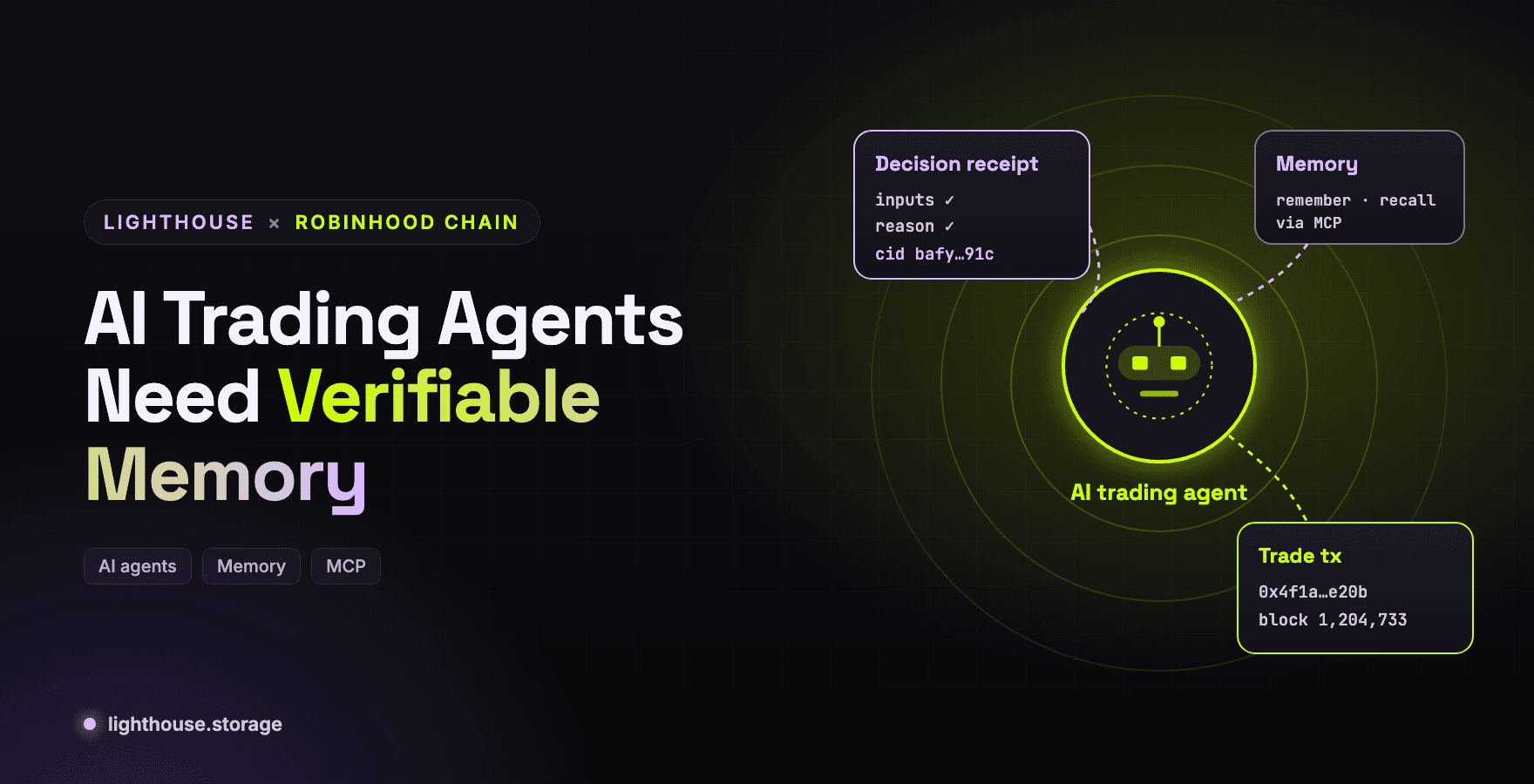
An agent that moves money has to answer one question later: why did it do that? If it cannot show what it read and what it decided, nobody should let it trade.
Robinhood calls its chain AI native. The homepage says it plainly: the chain is purpose built for AI agents that trade, swap, lend and transact with tokenized real world assets. Crypto focused Agentic Accounts are rolling out in the US, and at the mainnet launch in London an agent paying with Robinhood's agentic credit card sourced and ordered gifts for the attendees on its own.
The chain supplies the execution: 100 millisecond blocks, first come first served ordering, and ERC-4337 accounts with session keys. What it does not supply is the agent's memory. That gap decides whether an autonomous trader can be audited, resumed and trusted, or whether it is a black box with a wallet.
What Robinhood Chain Gives an Agent
| Capability | Why it matters for agents |
|---|---|
| ERC-4337 account abstraction | The agent operates a smart account, not the owner's private key |
| Session keys | Scoped, expiring permissions: specific contracts, specific limits |
| Gas sponsorship | The agent does not need to manage ETH balances to act |
| 100 ms blocks | Decisions settle fast enough for reactive strategies |
| FCFS sequencing | Order depends on arrival time, not priority fee bidding |
| Stock Tokens, Uniswap, Morpho, Lighter | Real assets and venues to act on, 24/7 |
This is a strong execution layer. An owner can hand an agent a session key that can only trade on specific pools, only up to a limit, and only until Friday. That solves "what can the agent do."
It does not solve "what did the agent know when it did it."
The Three Memory Problems
State dies with the process. Most agents keep context in memory or in a local vector database inside a container. Restart the container and the agent forgets its open positions, its reasoning, and the constraints its owner gave it last week.
Logs are assertions, not evidence. An agent can write "I read the Q3 earnings summary and the price was 187.40" to a log file. Anyone with access to that file can edit it afterwards. When a trade goes wrong, the log is the first thing questioned.
Context is not portable. An agent built in one framework, running on one machine, cannot hand its accumulated knowledge to another runtime without custom export code.
Onchain settlement makes these problems more acute, not less. The trade is permanent and public. The reasoning behind it is private and mutable. That asymmetry is exactly what a regulator, an auditor or an unhappy owner will focus on.
Decision Receipts: Pairing a CID With a Transaction
The simplest fix is also the most powerful. Before an agent acts, it writes the inputs and its reasoning to content addressed storage and gets back a CID. Then it acts onchain. Then it records the CID next to the transaction hash.
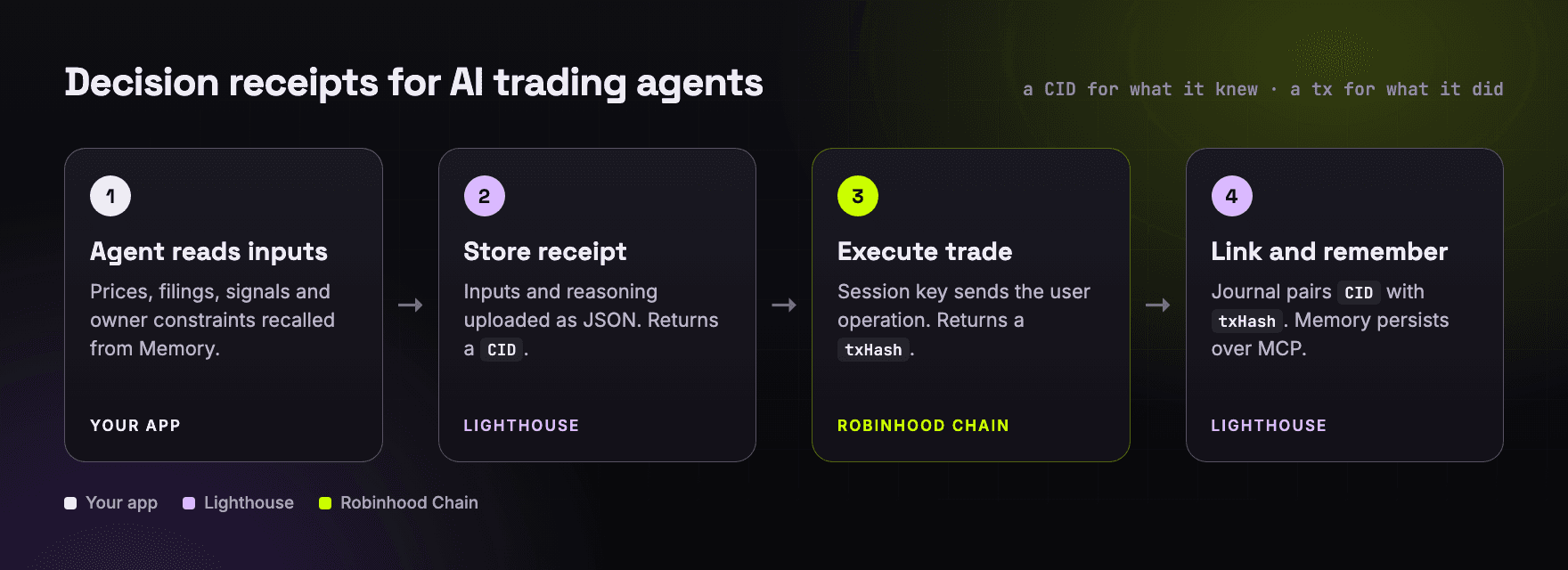
The result is two independently verifiable facts:
- A CID that proves exactly what the agent read and decided. Change a byte and the CID no longer matches.
- A transaction hash on Robinhood Chain that proves what it did.
Together they are a decision receipt. The log stops being a claim and becomes evidence that someone who was not there can check.
import lighthouse from "@lighthouse-web3/sdk";

async function tradeWithReceipt(agent, intent) {
  // 1. Snapshot inputs and reasoning before acting
  const receipt = {
    agent: agent.address,
    strategy: agent.strategyVersion,
    inputs: intent.inputs,          // price feeds, filings, signals the agent read
    reasoning: intent.rationale,    // model output that justified the trade
    order: intent.order,
    createdAt: new Date().toISOString(),
  };
  const { data } = await lighthouse.uploadText(
    JSON.stringify(receipt),
    process.env.LIGHTHOUSE_API_KEY,
    `receipt-${Date.now()}.json`
  );

  // 2. Execute on Robinhood Chain through the agent's session key
  const txHash = await agent.smartAccount.sendUserOperation(intent.order.calls);

  // 3. Link the two: CID of the reasoning, hash of the action
  await agent.journal.record({ cid: data.Hash, txHash });
  return { cid: data.Hash, txHash };
}
You can go one step further and emit the CID onchain in the same user operation, for example as calldata to a small journal contract. That costs a little gas and makes the link itself immutable and publicly indexed.
Memory That Survives Restarts: Lighthouse Memory
Receipts cover individual decisions. An agent also needs working memory: what its owner told it, what it has learned, which positions it holds and why.
Lighthouse Memory gives agents three primitives, remember, recall and forget, with each memory persisted as a blob addressed by an IPFS compatible CID.
- Resumes anywhere. Memory lives on the network, not in the container. Rebuild the entire store on a fresh machine from nothing but an API key.
- Semantic recall stays local. An in process embedding model ranks memories by a hybrid of similarity and keyword or tag overlap. No second API key, and no embedding data leaves the machine.
- Every flush is a backup. Pending memories batch into a single blob that carries the new records and a full index snapshot.
- Works over MCP. A bundled Model Context Protocol server exposes memory as tools to Claude Code, Claude Desktop and any MCP capable runtime.
In practice, the agent's system prompt tells it to remember owner constraints ("never hold more than 20 percent in one Stock Token") and to recall them before every order. When the agent migrates from a laptop prototype to a production server, the constraints come with it.
One limitation to hear from us first: Memory blobs are currently stored unencrypted, so anyone with a CID can read them. Keep secrets, keys and personal data out of Memory for now. Encrypted memory follows our encrypted upload support. For sensitive receipts, use encrypted uploads instead, covered below.
Walrus for AI Agents: Storage Shaped Like Agent Workloads goes deeper on why agent read and write patterns favor the Walrus backend for Memory.
Private Strategy, Auditable Outcome
A trading agent's reasoning is often commercially sensitive. Publishing it to public IPFS would hand the strategy to competitors. The answer is to encrypt the receipt and share it selectively.
With Lighthouse encrypted uploads, the file is encrypted client side and its key is split across independent key nodes with threshold cryptography. The CID is still public and still anchors the receipt onchain, so integrity is verifiable by anyone. Contents are readable only by parties you name, such as the account owner and an auditor. Access can be revoked later.
That gives you the combination regulated finance needs: everyone can verify the record exists and has not changed, and only authorized parties can read it.
Patterns Worth Building on Robinhood Chain
Owner facing agent dashboards. Every trade in the UI links to its receipt CID. The owner clicks through to see exactly what the agent read.
Strategy versioning. Store each strategy prompt and parameter set by CID. A receipt that references strategyCID proves which version of the strategy produced the trade.
Multi agent desks. A research agent writes filing summaries to storage; an execution agent recalls them. Each handoff is a CID, so a bad trade can be traced to the input that caused it.
Evaluation datasets. Replay historical receipts against a new model version to compare decisions before promoting it. Storing AI Training Data on Filecoin: Provenance You Can Prove covers dataset provenance.
Compliance archives. Receipts retained on the Filecoin path with deal proofs, for records that must be kept for years and read rarely.
Frequently Asked Questions
Is Robinhood Chain built for AI agents? Yes. Robinhood describes it as an AI native Layer 2 purpose built for agents that trade, swap, lend and transact with tokenized real world assets. ERC-4337 accounts with session keys and gas sponsorship make agent wallets practical.
Where should an AI trading agent store its memory? Outside the process, in persistent storage the agent can rebuild from. Lighthouse Memory stores each memory as a CID addressed blob on Walrus or Filecoin and exposes it over MCP.
What is a decision receipt? A record of an agent's inputs and reasoning stored by CID before it acts, paired with the transaction hash of the action. It lets anyone verify what the agent knew when it traded.
Can agent reasoning stay private? Yes. Upload receipts encrypted and share them with named parties. The CID still proves integrity without revealing contents.
Get Started
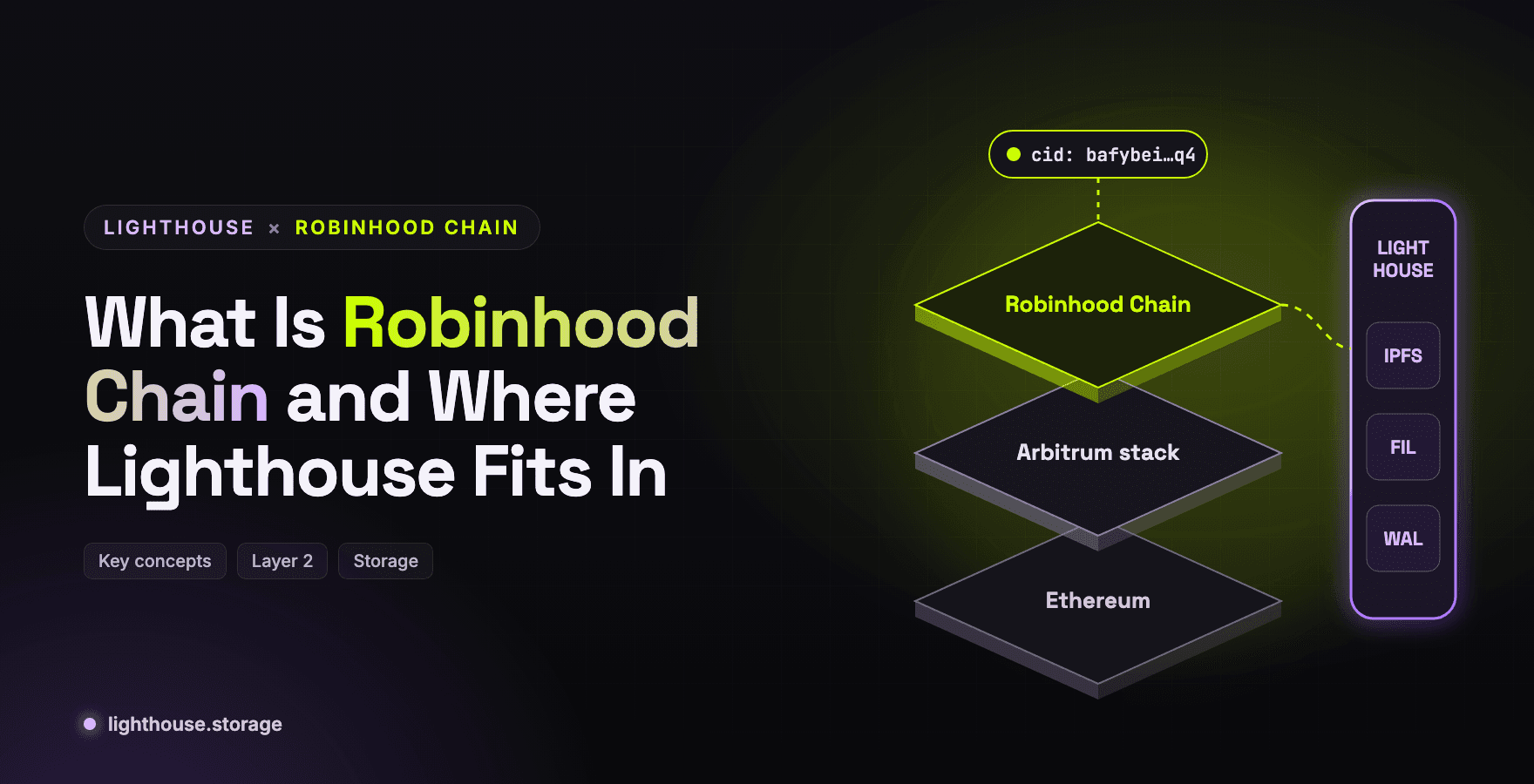
For the wider stack, read What Is Robinhood Chain and Where Lighthouse Fits In. Building an agent on Robinhood Chain? Talk to our team.
Stay in Touch
Learn more at the website, docs, or GitHub. Join the community on Discord, X, Telegram, and LinkedIn.