Building DeFi Apps on Robinhood Chain with Decentralized Storage
A DeFi protocol is only as decentralized as its weakest dependency. On most protocols, that dependency is a frontend on a single cloud account.
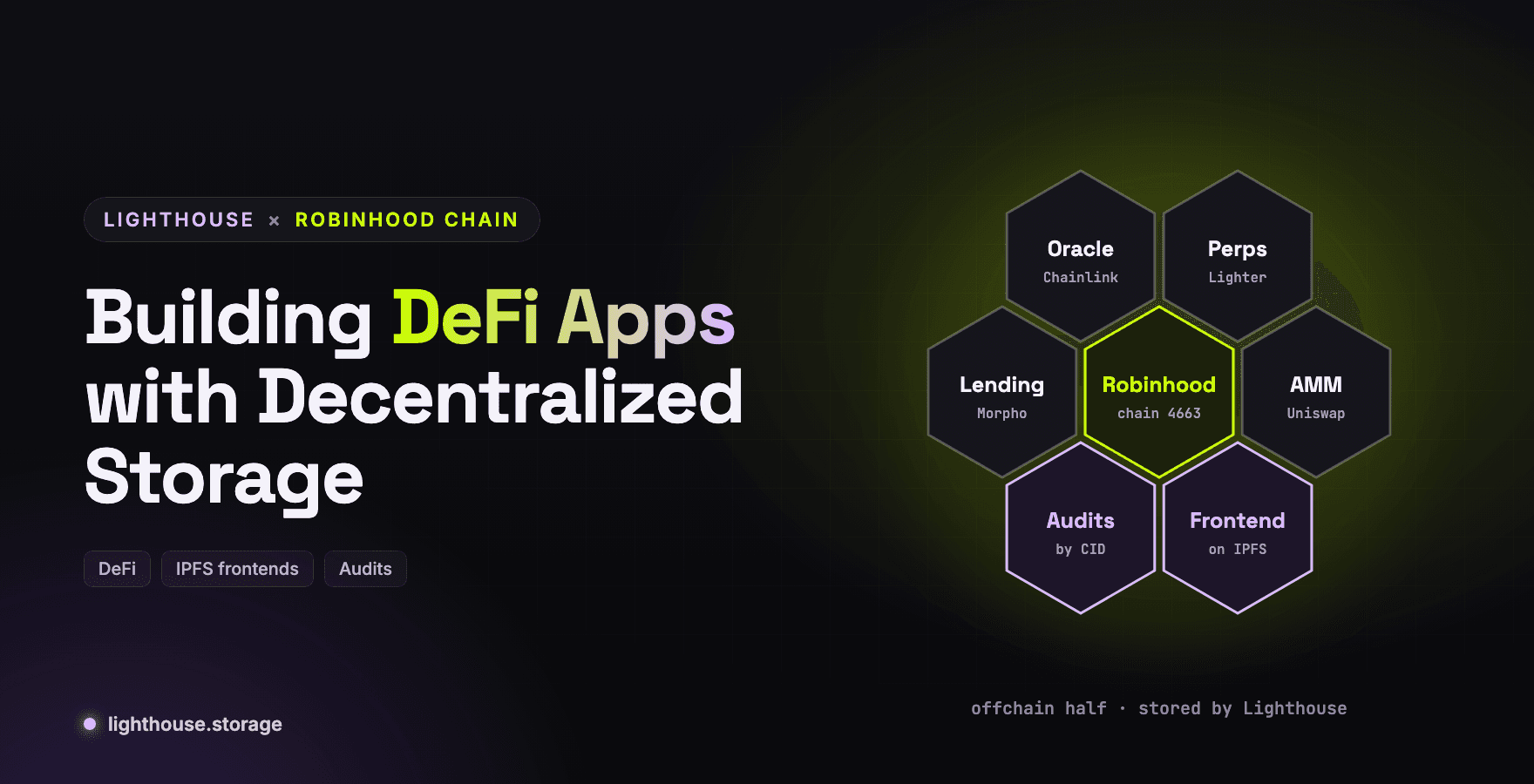
Robinhood Chain launched with a DeFi stack in place on day one: a dedicated Uniswap AMM for public liquidity, Pleiades for prop trading, Morpho for lending, Lighter and Arcus for perpetuals, Chainlink oracles, LayerZero messaging and Paxos USDG as a dollar stablecoin. Stock Tokens can be deposited into lending pools and used as trading collateral.
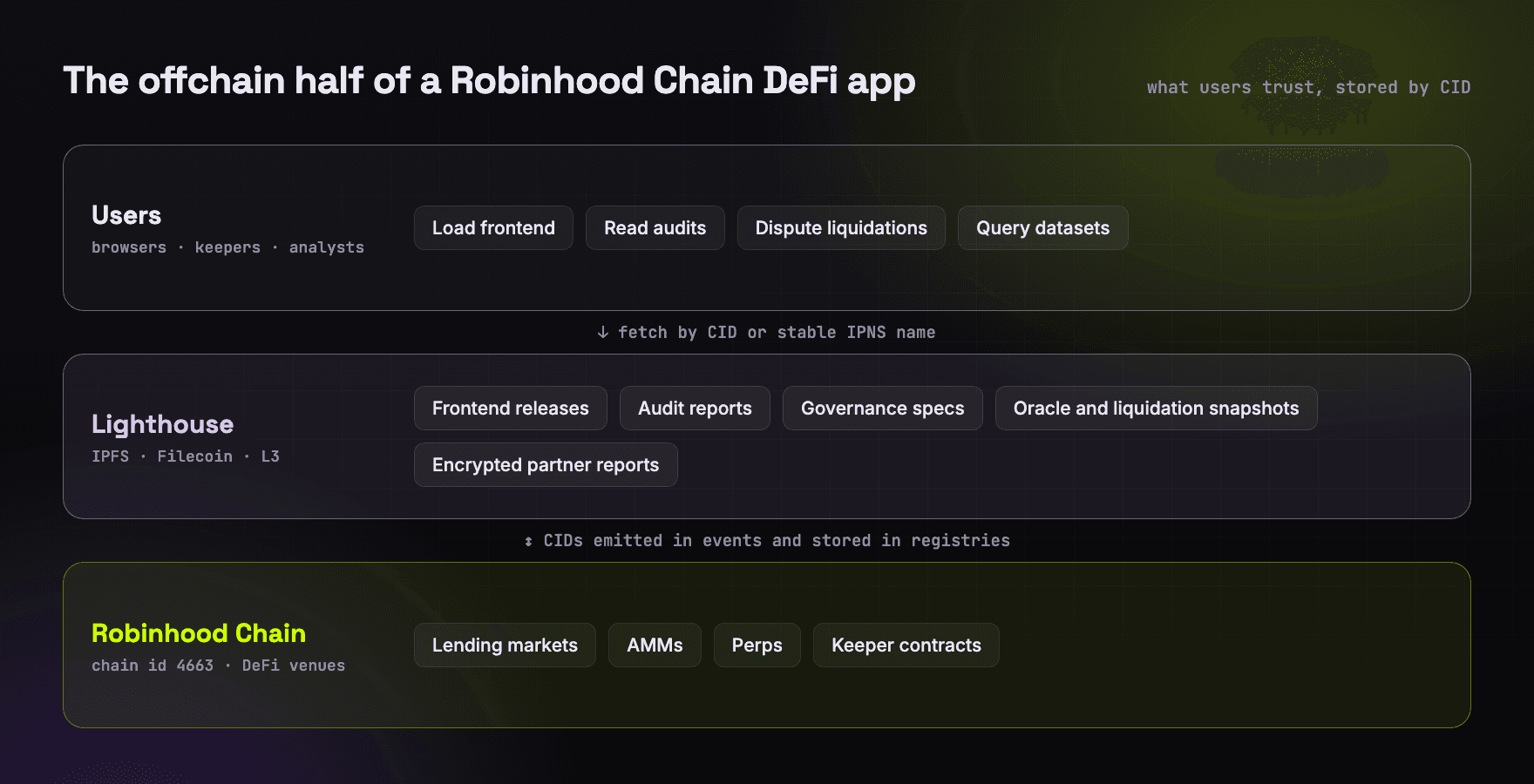
That is a lot of new surface area for builders: lending markets for tokenized equities, structured products, vaults, aggregators and risk dashboards. The contracts get audited. The offchain half of each protocol rarely gets the same attention. This guide covers that half and where Lighthouse fits.
The Offchain Half of a DeFi Protocol
| Component | Typical home | Risk | Better home |
|---|---|---|---|
| Web frontend | Cloud hosting behind a DNS name | Takedown, DNS hijack, silent code change | IPFS, versioned by CID |
| Audit reports | PDF on a website | Swapped or removed after an incident | CID recorded onchain |
| Governance proposals and specs | Forum post, doc link | Edited after the vote | CID in the proposal |
| Oracle and price snapshots | Internal database | Unverifiable during disputes | Archived by CID, backed by Filecoin deals |
| Liquidation and risk reports | Internal database | Cannot be independently checked | Published by CID |
| Historical analytics datasets | Cloud buckets | Lock in, egress costs | S3 compatible decentralized storage |
Every row has the same theme. The data that users and integrators rely on to trust a protocol can be changed or removed by whoever controls a server. Content addressing turns each of these into something verifiable.
1. Host the Frontend on IPFS
A user interacting with a lending market for Stock Tokens signs transactions the frontend builds. If an attacker changes the frontend, users sign the attacker's transactions. Frontend compromise through DNS hijacking or a leaked deploy credential has drained users on major protocols more than once.
Publishing the built frontend to IPFS gives every release a CID. The CID is the exact set of files users load, and it cannot be modified without producing a different CID.
# Build and publish a static frontend with the Lighthouse CLI
npm run build
lighthouse-web3 upload ./out
# => CID: bafybei...  (this CID is your release)
Then point a stable name at it. An IPNS key lets you publish new releases under one name; DNSLink maps your domain to the current CID. Publish each release CID in your repo and on your governance forum so users can verify what they are loading. IPNS or DNSLink? Choosing a Mutable Pointer explains how to choose.
2. Anchor Audits and Governance by CID
When a proposal says "upgrade to the implementation described in the attached spec," the attachment should be a CID, not a link. The vote then binds to an exact document.
import lighthouse from "@lighthouse-web3/sdk";

const audit = await lighthouse.upload("./audits/lending-v2-final.pdf", process.env.LIGHTHOUSE_API_KEY);

// Store the CID in the protocol's metadata registry on Robinhood Chain (chain ID 4663)
await registry.write.setAuditReport(["lending-v2", audit.data.Hash]);
Anyone can later fetch the audit by CID, hash it, and confirm it is the report the contract points to. A post incident edit becomes detectable instead of deniable.
3. Archive Oracle, Liquidation and Risk Data
Lending against tokenized equities means liquidations will happen around price moves in the underlying stock, including moves that happen while traditional markets are closed and Stock Tokens keep trading. When a user disputes a liquidation, the protocol needs to show the price data and parameters it acted on.
A useful pattern: every hour, or every liquidation batch, the keeper serializes the oracle readings, market parameters and positions touched, uploads the bundle to Lighthouse, and emits the CID in an event.
const snapshot = {
  block: await publicClient.getBlockNumber(),
  market: "STOCK-TOKEN/USDG",
  oracle: { source: "chainlink", price: latestPrice, updatedAt },
  params: { lltv: "0.77", liquidationIncentive: "0.05" },
  liquidated: batch.map((p) => ({ account: p.account, repaid: p.repaid, seized: p.seized })),
};

const { data } = await lighthouse.uploadText(JSON.stringify(snapshot), process.env.LIGHTHOUSE_API_KEY, `liq-${snapshot.block}.json`);
await keeper.write.recordSnapshot([snapshot.block, data.Hash]);
On the Filecoin path, these archives are held in storage deals with ongoing proofs, which matters for records you may need to produce long after the fact. See How to Verify Your File Is Actually Stored on Filecoin.
4. Analytics Data Without Rewriting Your Pipeline
Risk teams and analytics services already have pipelines that write to S3. Lighthouse's L3 is an S3 compatible API that speaks AWS Signature V4, so the AWS CLI, boto3, rclone and the AWS SDKs work unchanged. Every object response includes its CID in the x-amz-meta-cid header.
aws s3 cp ./positions-2026-09-18.parquet s3://robinhood-risk/daily/ \
  --endpoint-url https://s3.lighthouse.storage
Moving the data is a config change, not a migration project, and each dataset gains a content identifier you can cite in reports.
5. Gated Research and Partner Data
Not all protocol data should be public. Institutional depositors may receive detailed risk reports; integration partners may get pre release parameters. Lighthouse encrypts client side with threshold key management, so you can publish the CID openly while sharing decryption with named addresses, and revoke access when a relationship ends.
Chain support note. Condition based gating reads contract state from chains on Lighthouse's Chains Supported list, and Robinhood Chain is not there yet. Address based sharing and revocation work today. For conditions such as "holds at least 1,000 USDG on Robinhood Chain," request support on Discord.
A Checklist Before Mainnet
- Frontend published to IPFS, release CID announced, stable name via IPNS or DNSLink.
- Audit reports uploaded and their CIDs recorded in a contract or deployment manifest.
- Governance templates that require CIDs for attached specs.
- Keeper snapshots archived by CID with events emitted onchain.
- Analytics buckets pointed at an S3 compatible, content addressed endpoint.
- Sensitive reports encrypted, with an owner for access reviews and revocation.
None of this changes your contracts. All of it changes what you can prove when something goes wrong.
Frequently Asked Questions
What DeFi protocols are on Robinhood Chain? At launch: Uniswap (dedicated AMM), Pleiades, Morpho for lending, Lighter and Arcus for perpetuals, Chainlink oracles, LayerZero for cross chain messaging and Paxos USDG.
Can I host a dApp frontend on IPFS? Yes. Upload the static build to IPFS with Lighthouse, then use IPNS or DNSLink so a stable name points at the latest release CID.
Why store DeFi data by CID? A CID is derived from the content, so it proves a file has not changed. Recording CIDs onchain makes audits, proposals and liquidation data independently verifiable.
Does Lighthouse work with S3 tools? Yes, through L3, an S3 compatible API at s3.lighthouse.storage that returns each object's CID.
Get Started
- Lighthouse quick start
- L3, the S3 compatible API
- IPNS and mutable data
- Robinhood Chain developer docs
Related reading: Stock Tokens and RWA Documents on Robinhood Chain with Lighthouse Storage. Building a protocol on Robinhood Chain? Talk to our team.
Stay in Touch
Learn more at the website, docs, or GitHub. Join the community on Discord, X, Telegram, and LinkedIn.