Agentic Commerce on Arc with x402 Nanopayments and Lighthouse
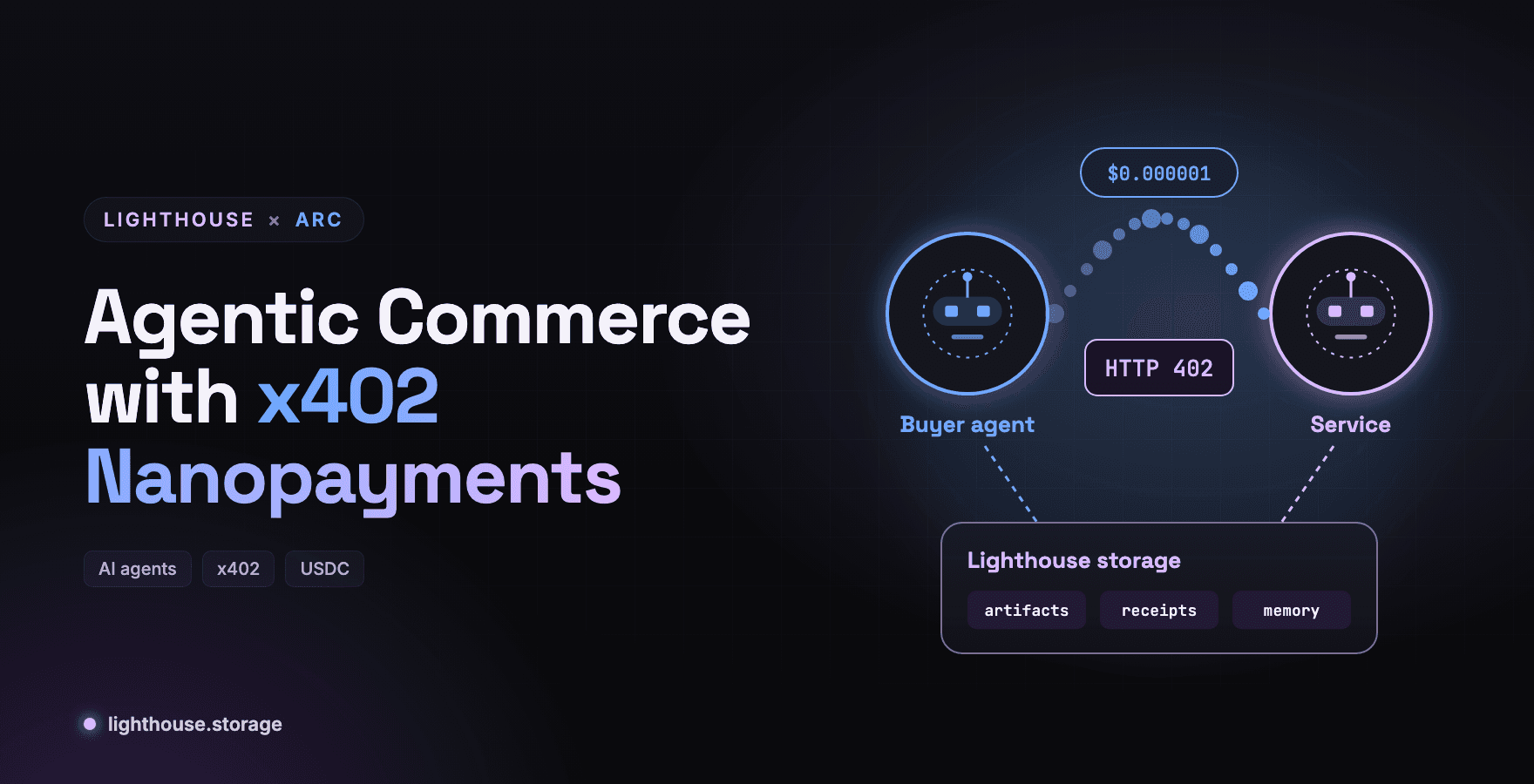
The agent economy needs three things at once: money that settles instantly, prices small enough to charge per request, and a place to keep what was bought. Arc supplies the first two. Lighthouse supplies the third.
Circle's own figure is striking: USDC accounts for 98.8 percent of agent driven transaction volume. Arc is Circle's bet that agents will transact on a chain where the gas token is the same dollar they spend, finality is sub second, and payments can be smaller than a cent without the fee eating them.
This post explains how agentic commerce works on Arc, where x402 fits, and how Lighthouse gives agents storage they can pay for in USDC, memory that survives restarts, and receipts that prove what they bought.
The Circle Agent Stack on Arc
| Component | What it does |
|---|---|
| Agent Wallets | Wallets agents control within policies their owners set |
| Nanopayments | Sub cent USDC payments using x402, settled in batches through Circle Gateway |
| Agent Marketplace | Discovery of x402 services agents can pay for |
| AgentVM (in development) | Execution for agents handling sensitive data, with immutable records |
| USDC gas | Agents budget in dollars, with no second token to manage |
| Sub second finality | Payments are final before the agent's next step |
The piece that ties it together is x402.
x402 in One Paragraph
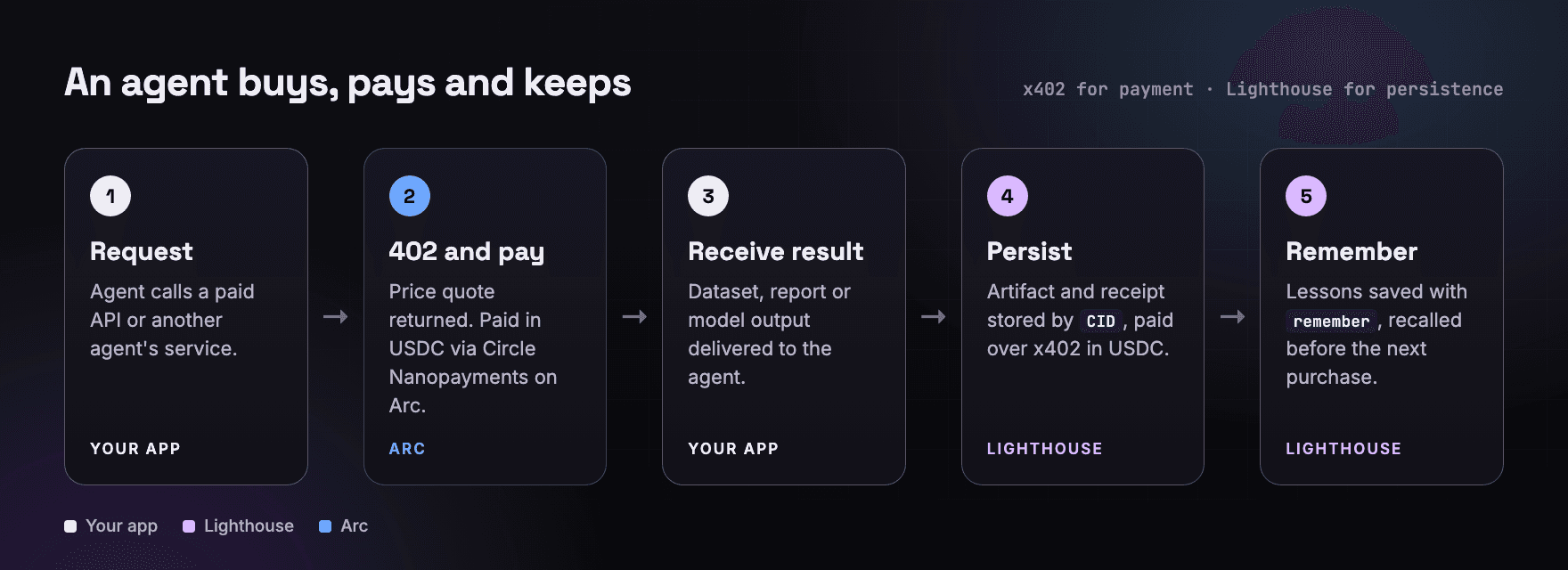
HTTP has had a 402 Payment Required status code since the 1990s with nothing behind it. x402 gives it a job. A client requests a resource. The server replies 402 with a price and a pay to address. The client pays in USDC, retries with proof of payment, and receives the resource. No API key, no account, no subscription. For agents this is ideal: payment becomes part of the request, the same way authentication is.
Circle Nanopayments make x402 economical at tiny prices. Instead of settling every call onchain, buyers fund a Gateway balance once, sign offchain payment authorizations per request, and Gateway settles net positions in bulk on Arc. That is how prices as low as $0.000001 per call become workable.
What Agents Buy, and What They Must Keep
An agent on Arc might pay per call for market data, per page for a research API, per inference for a specialist model, or per task for another agent's work. Each purchase produces something:
- An artifact. A dataset, a generated report, an image, a model output.
- A receipt. Proof of what was paid, to whom, for what.
- Context. What the agent learned that it should remember for next time.
If all three live in a container's memory, they vanish on restart. The agent paid real dollars for them. It should keep them in storage that outlives the process, that it can pay for itself, and that it can prove.
Storage an Agent Can Pay For: Lighthouse over x402
Lighthouse already sells storage over x402. An agent POSTs a file, receives a 402 quote priced by file size, pays in USDC, and gets back a CID. No API key and no human with a credit card.
import { x402Client, wrapFetchWithPayment } from "@x402/fetch";
import { registerExactEvmScheme } from "@x402/evm/exact/client";
import { privateKeyToAccount } from "viem/accounts";

const signer = privateKeyToAccount(process.env.AGENT_KEY);
const client = new x402Client();
registerExactEvmScheme(client, { signer });
const payFetch = wrapFetchWithPayment(fetch, client);

// Persist something the agent just bought
const artifact = new Blob([JSON.stringify(purchasedReport)], { type: "application/json" });

const res = await payFetch(`${LIGHTHOUSE_X402_URL}/api/upload`, {
  method: "POST",
  headers: { "Content-Type": "application/octet-stream", "x-file-name": "report.json" },
  body: artifact,
});
const { cid } = await res.json();
Two properties make this useful for agents:
Two proofs per upload. The CID proves what was stored. The payment response header carries the settlement transaction hash, which proves what was paid. Together they are an audit trail an agent produces without extra work.
Retention is renewable the same way. Storage bought over x402 on the IPFS and Filecoin path carries a one year term. Renewing is another x402 call, so an agent can be given a budget and a renewal schedule and left alone.
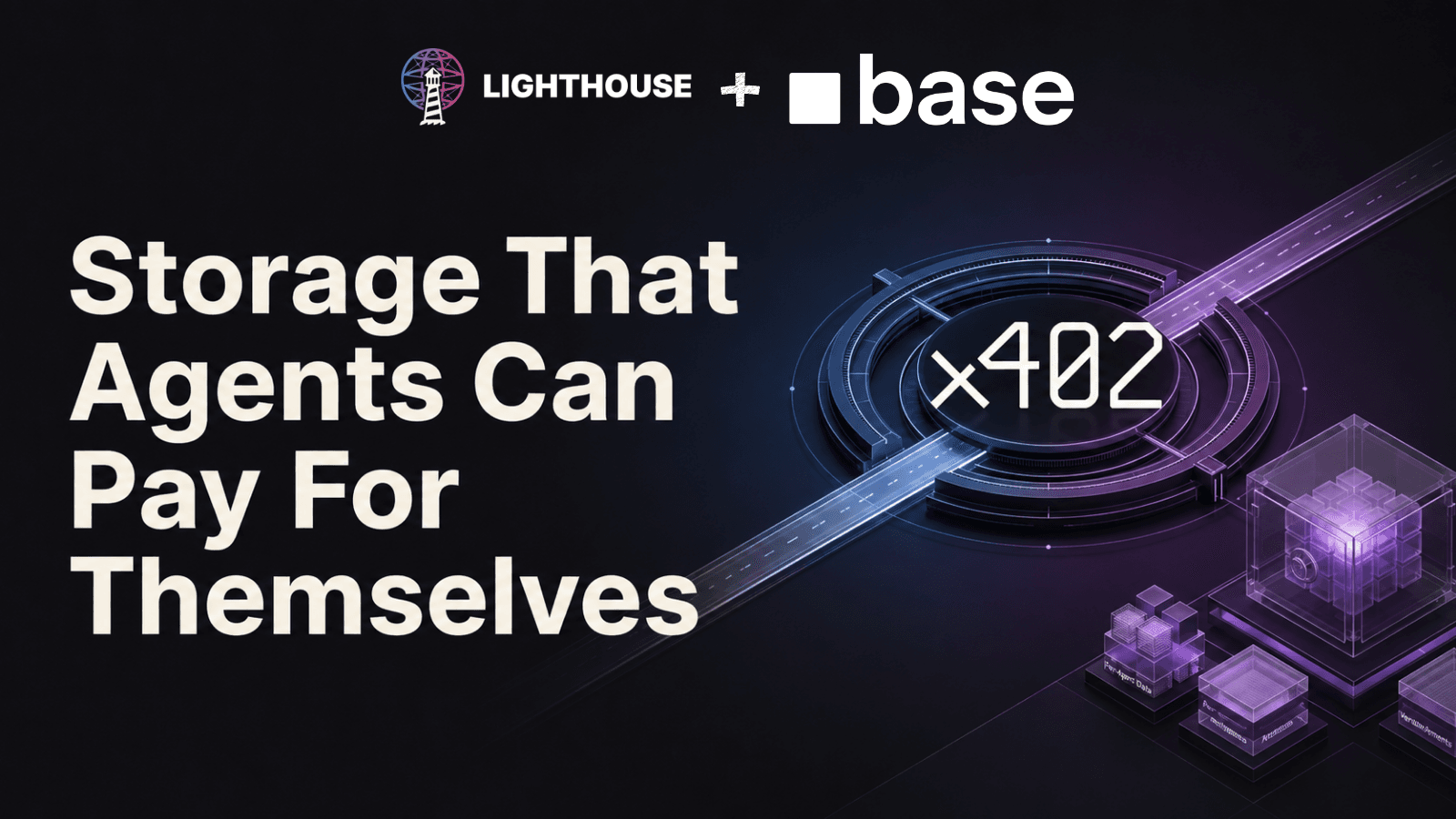
Chain note, stated plainly. Lighthouse's x402 endpoints settle in USDC on Base mainnet today, not on Arc. An Arc native agent can hold USDC on Arc for its purchases and keep a storage budget on Base, moving USDC between the two with Circle's crosschain infrastructure. The request pattern is identical, and both sides speak x402. Lighthouse x Base: Storage That Agents Can Pay For Themselves covers the Base integration in full.
Memory That Travels With the Agent
Receipts and artifacts are files. An agent also needs working memory: its owner's instructions, spending policies, which vendors delivered, which ones failed.
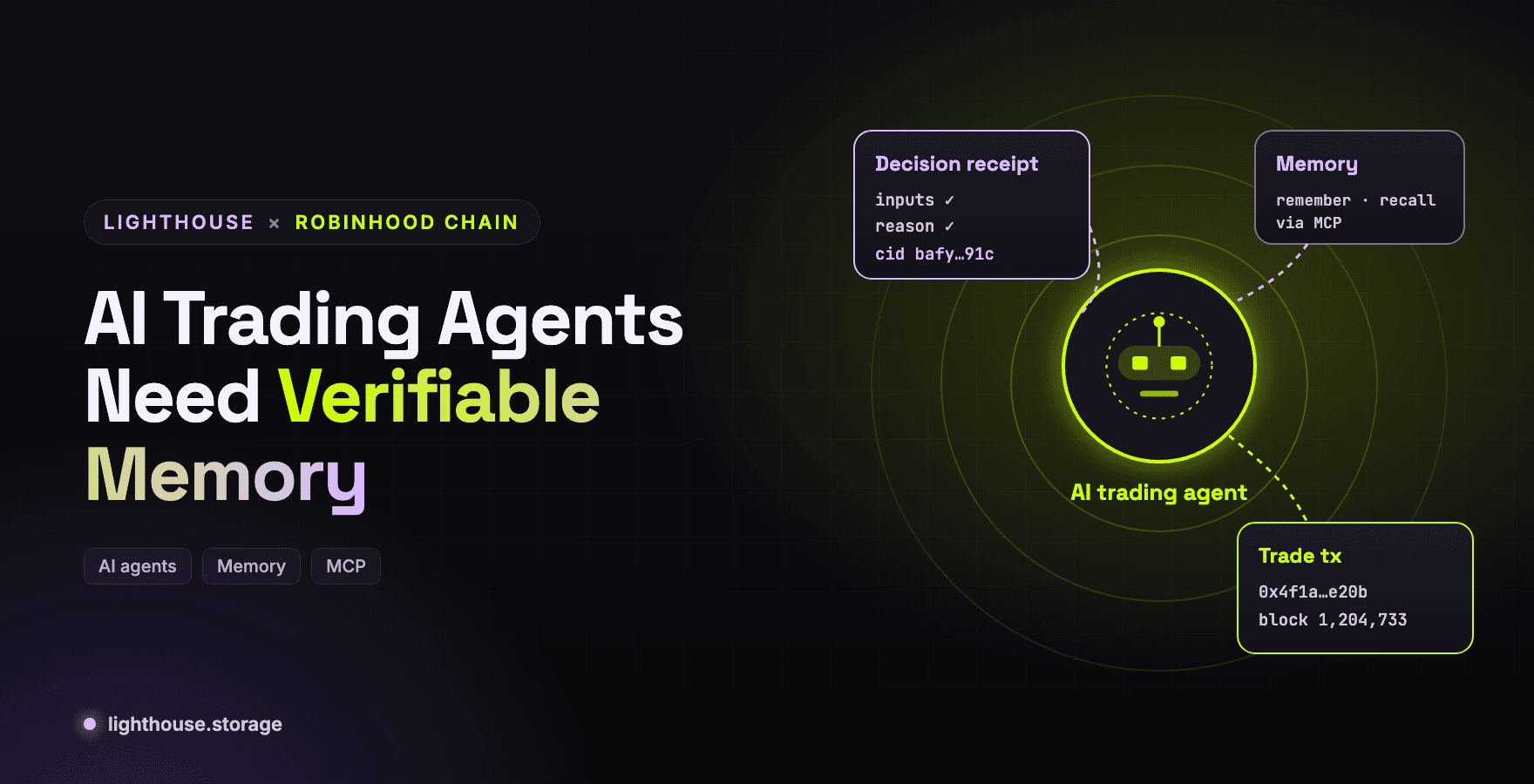
Lighthouse Memory provides remember, recall and forget for agents, with every memory persisted as a verifiable blob addressed by an IPFS compatible CID.
- Memory lives on the network, so an agent resumes across sessions, machines and runtimes, and rebuilds its store from nothing but an API key.
- Semantic recall runs locally with an in process embedding model. No extra API key; no embedding data leaves the machine.
- A bundled MCP server exposes memory as tools to Claude Code, Claude Desktop and any MCP capable runtime.
A purchasing agent can remember that a data vendor returned stale prices last Tuesday and recall it before paying that vendor again. Over weeks, that is the difference between an agent that spends money and one that spends it well.
Limitation: Memory blobs are currently stored unencrypted, and anyone with a CID can read them. Do not store secrets, keys or personal data in Memory yet. For sensitive material, use encrypted uploads.
Selling to Agents: Data Vendors on Arc
The other side of agentic commerce is the seller. If you run a dataset, a research feed or a model on the Agent Marketplace, your deliverables are files.
A clean pattern for x402 sellers:
- Store the paid resource encrypted on Lighthouse.
- When the Nanopayment settles, share decryption with the buyer's address, or return a short lived link to the decrypted content.
- Log the CID of what was delivered with the payment reference.
If a buyer later disputes what they received, the CID settles it. The delivered bytes either match the CID or they do not.
Agent Patterns Worth Building on Arc
Research agents with citations by CID. Every source an agent paid for is stored and cited by CID in its final report.
Procurement agents with policy memory. Spending rules and vendor history in Memory, recalled before every purchase.
Agent to agent work markets. One agent pays another per task on Arc; deliverables are exchanged by CID so both sides can prove what changed hands.
Dataset licensing. Evaluation or training data shared under conditions and revocable later. See Storing AI Training Data on Filecoin: Provenance You Can Prove.
Compliance trails for regulated agents. Receipts retained on the Filecoin path, paired with Arc transaction hashes, for records that auditors will ask for.
Frequently Asked Questions
What is agentic commerce? AI agents buying and selling services autonomously, paying per use in stablecoins without a human approving each transaction.
What are Circle Nanopayments? Sub cent USDC payments built on x402 and Circle Gateway. Buyers sign offchain authorizations per request and Gateway settles net positions onchain in batches on Arc.
How does an AI agent pay for storage?
With x402. Lighthouse returns a 402 price quote for an upload, the agent pays in USDC, and the upload completes with a CID. Lighthouse's x402 endpoints currently settle on Base.
Where should an AI agent keep its memory? Outside the process, in persistent storage it can rebuild from. Lighthouse Memory stores memories as CID addressed blobs and exposes them over MCP.
Get Started
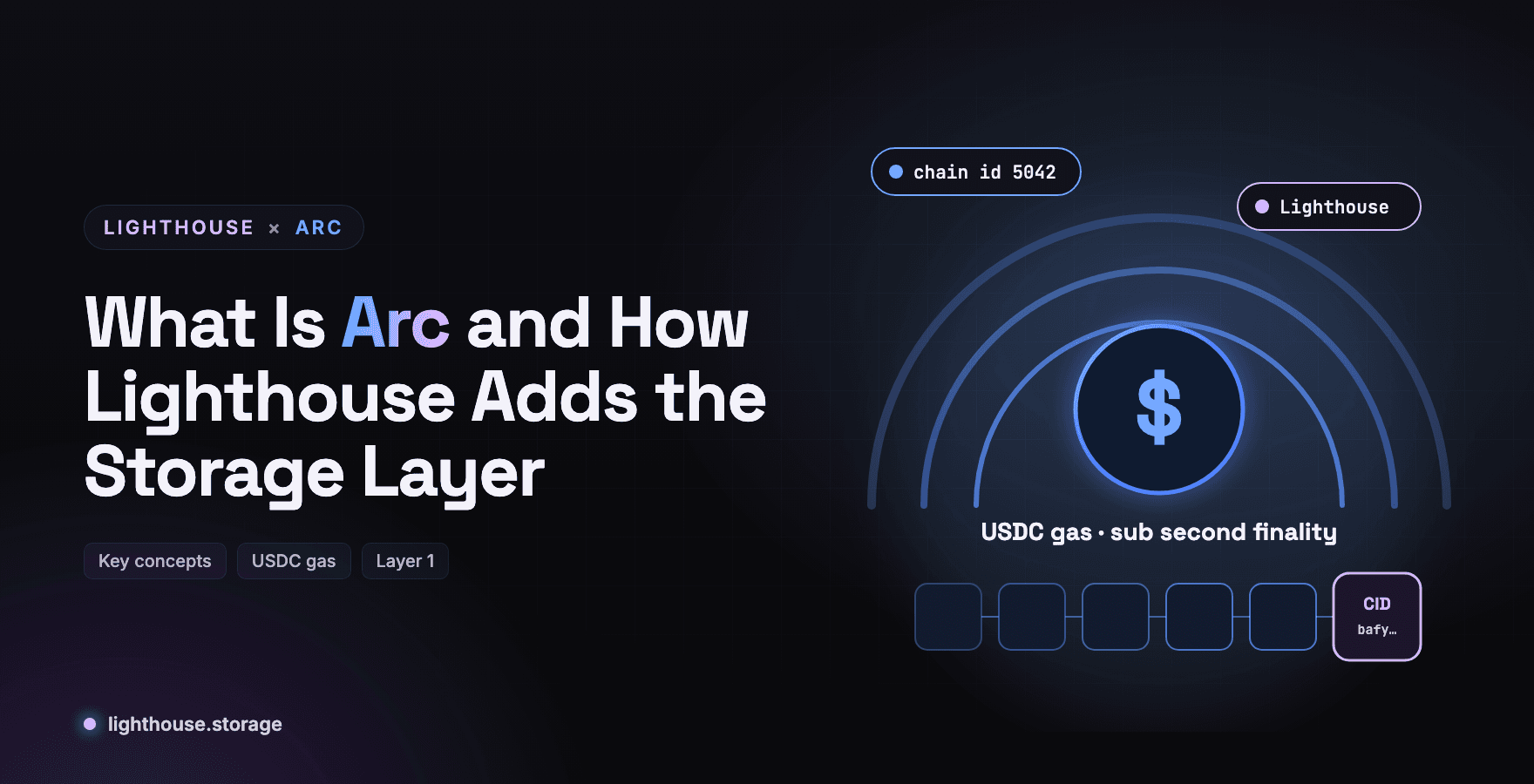
New to Arc? Read What Is Arc by Circle and How Lighthouse Adds the Storage Layer. Building agents on Arc? Talk to our team.
Stay in Touch
Learn more at the website, docs, or GitHub. Join the community on Discord, X, Telegram, and LinkedIn.